

Speak Hellenic
- Problem solved. Upper intermediate Greek has almost no material. Learners stall where one unknown word kills a whole sentence.
- Angle taken. Teach the way I actually learned: read real Greek, tap what stops you, meet it again before you forget it. No grammar drills, no beginner dialogues.
- What it is. 324 lessons across 34 modules, charted as 18 islands in the Aegean. Tap any word for an inline translation and it saves itself to your word bank.
- Tech used. Next.js 15, React 19 and TypeScript on AWS Amplify. AWS CDK, Lambda, API Gateway, DynamoDB and S3 behind it. Over 2,000 tests across Vitest, Jest and Playwright.
- Call I would defend. Rendering every lesson's audio ahead of time rather than synthesising on request, which killed the cost per play and the latency in one move.
- Where it stands. Live at speakhellenic.com, with 391 lessons completed and 6,115 words saved by real learners.
The problem I could not buy my way out of
I am half Greek, and I have been studying the language for over ten years. For most of that time the obstacle was not effort. It was that the material ran out.
Beginner Greek is a crowded market. You can find a hundred apps that will teach you to order a coffee. What almost nobody builds is the thing after that: the upper intermediate stretch where you can follow a conversation until one unfamiliar word detonates the whole sentence, and the meaning is simply gone.
That is the intermediate plateau, and it is where most serious learners quietly stop. My own way through it was unglamorous: read real Greek, write down the words I did not know, and work them out from context. It worked. It was also tedious, unstructured, and impossible to keep up on a bad week.
Speak Hellenic is that method, built properly.
A course that looks like a journey, not a syllabus
A reading course of 324 lessons could very easily feel like a spreadsheet. So the course is not presented as a list of modules. It is a chart of the Aegean, and you sail it.
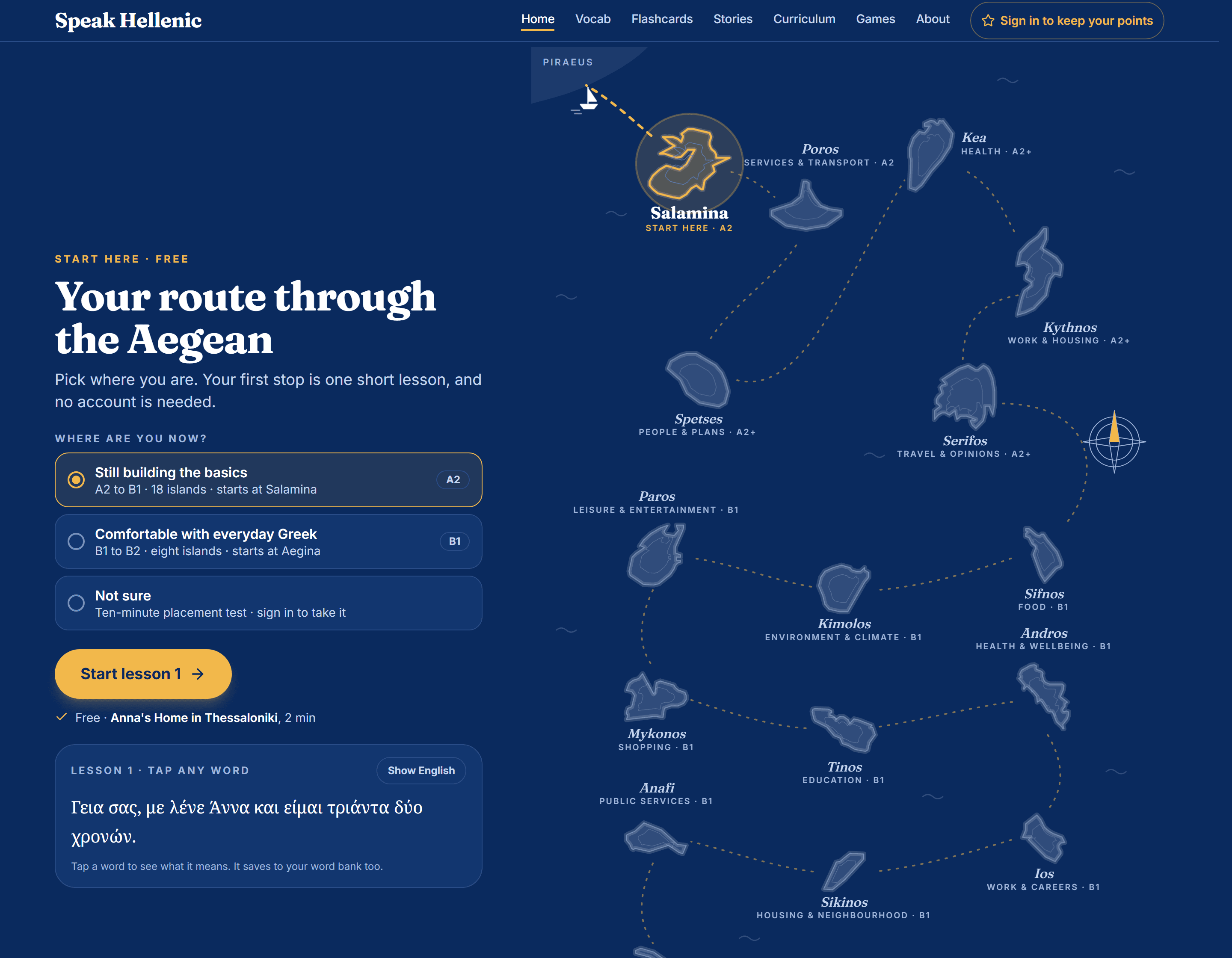
Each island is a topic: Home Life, Services & Transport, Work & Housing, Food, Identity & Life Story. Each one has ten stops. The route gives a sense of distance travelled and distance left. You can see that you are on island three of eighteen, and you can see where the journey ends.
Two deliberate decisions sit in that first screen. The first lesson is free and needs no account, because asking someone to sign up before they know whether they like your teaching is a bad trade. And a 12 part quiz places each learner at the right starting point.
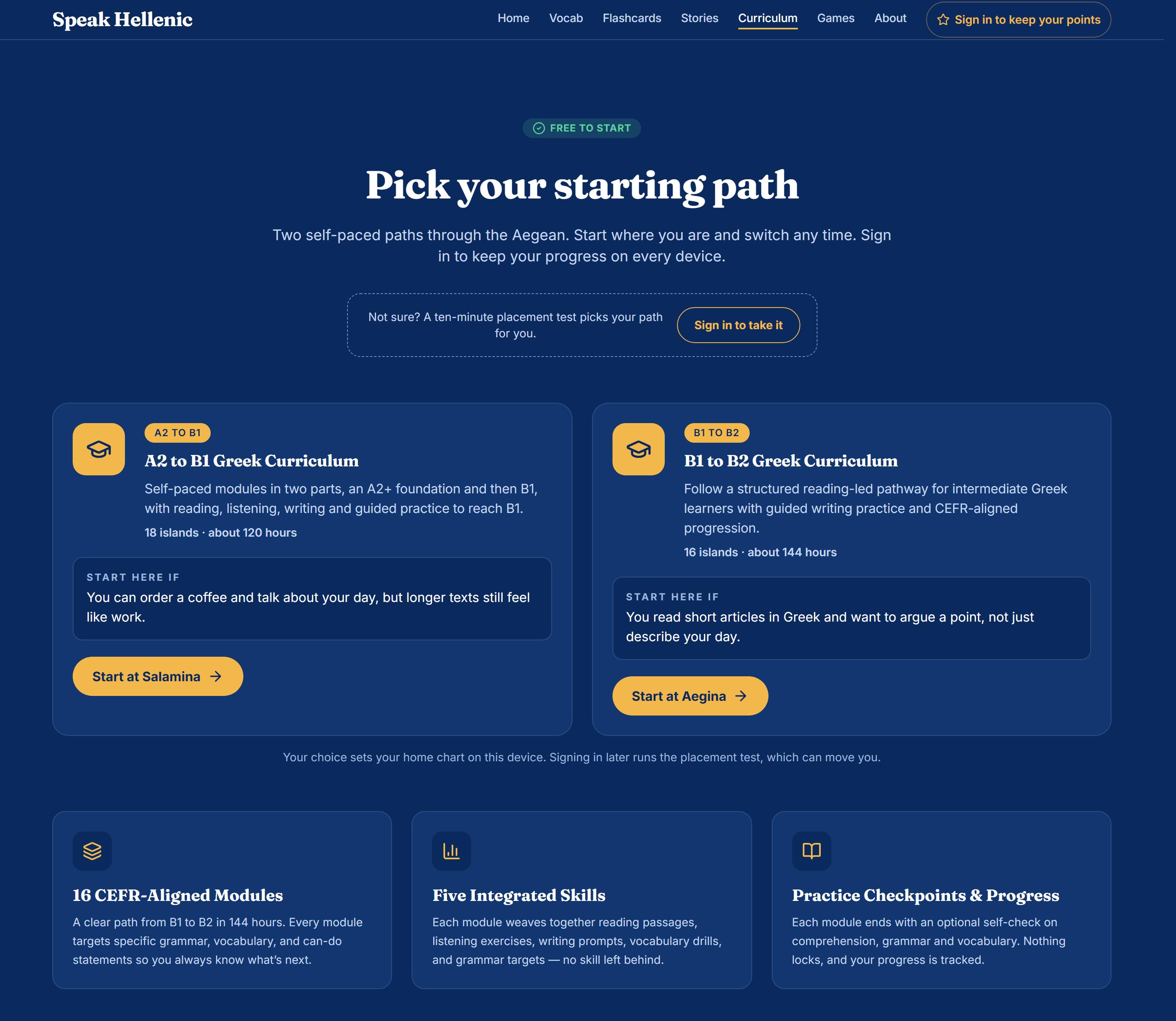
Notice how the paths are described. Not "A2" and "B1", but you can order a coffee and talk about your day, but longer texts still feel like work. Learners rarely know their CEFR level. They always know whether longer texts feel like work.
The core move: tap the word that broke the sentence
Everything in the product serves one interaction. You read a passage in Greek, and the moment a word stops you, you tap it.
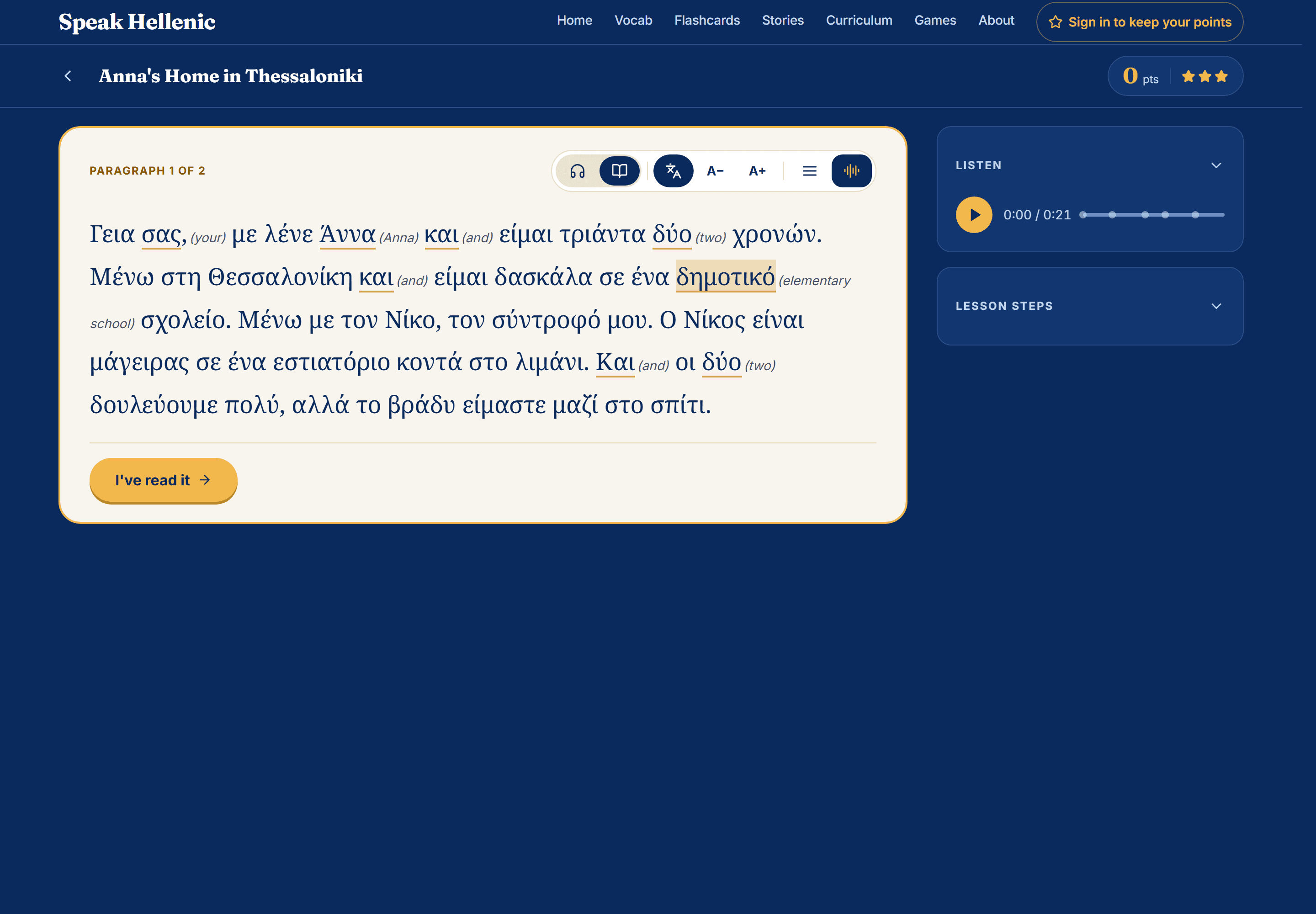
The translation appears inline, beside the word, so the sentence you were reading never disappears behind a modal. And the word is quietly added to your word bank on the way past. That is the whole trick: the thing you do when you are stuck is also the thing that builds your vocabulary list, so the list is never a separate chore you have to remember to do.
The passage is read aloud too, at three speeds, with the audio rendered ahead of time rather than synthesised on demand, so it plays instantly and costs nothing per play.
Comprehension you cannot bluff
After reading, the text hides and the question arrives in Greek.
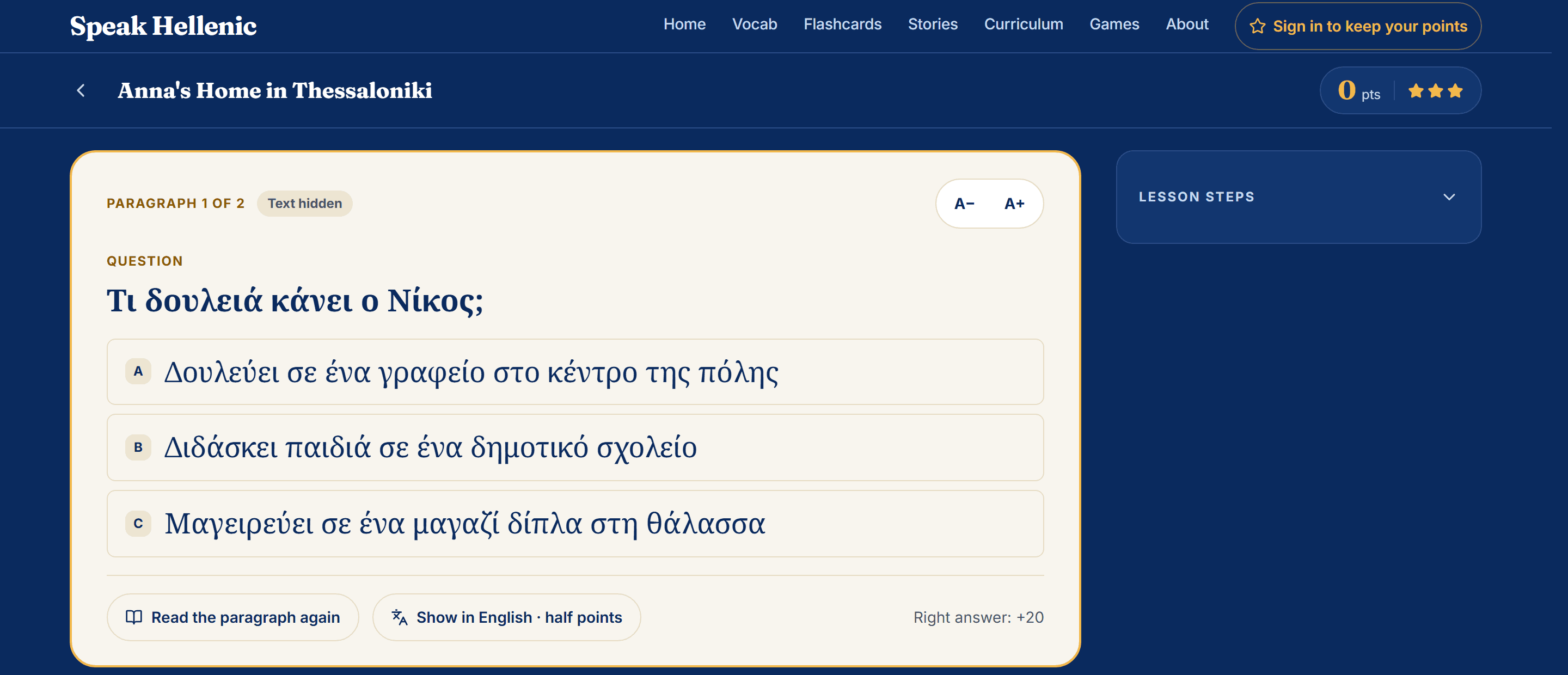
Hiding the paragraph is deliberate. If the text stays on screen, you match patterns; you do not comprehend. The English translation is still one tap away, but it costs you half the points. The incentive leans toward staying in Greek without ever locking you out of understanding.
Words come back before you lose them
A word tapped once is a word forgotten by Thursday. Saved words return on a spaced schedule: one day, then three, seven, fourteen, thirty. A missed word drops back to the start rather than waiting at the end of the queue.
Review is framed as a game called Σωσίβιο, Lifebuoy: your words are drifting out to sea and you rescue them before they are out of reach. The other games are Greek too. Λεξικό is one Greek word a day in six guesses, Τόνος drills the stressed syllable, and Φτιάξε rebuilds scrambled sentences. The English scaffolding falls away everywhere it can.
Everything else a stuck learner reaches for
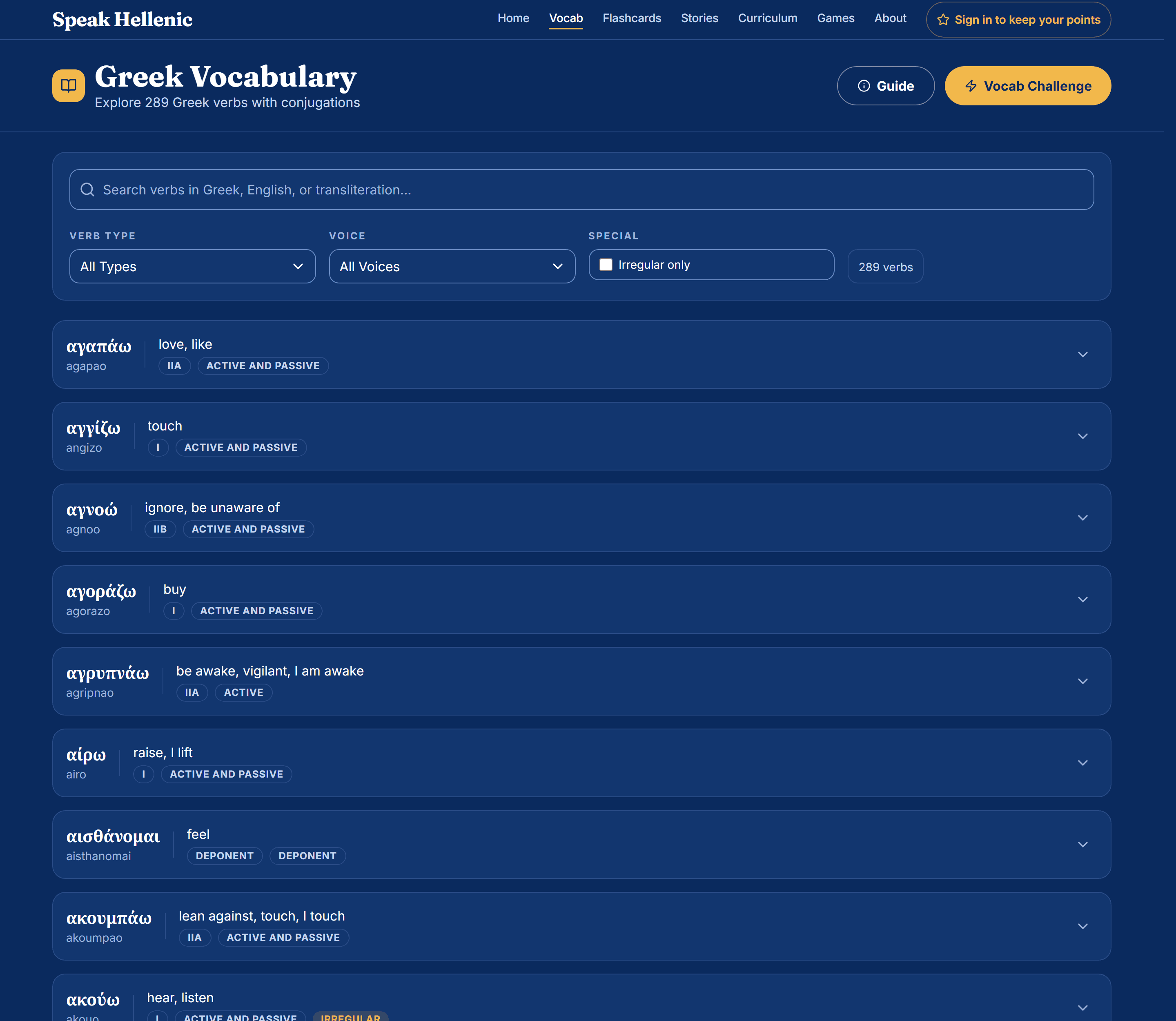
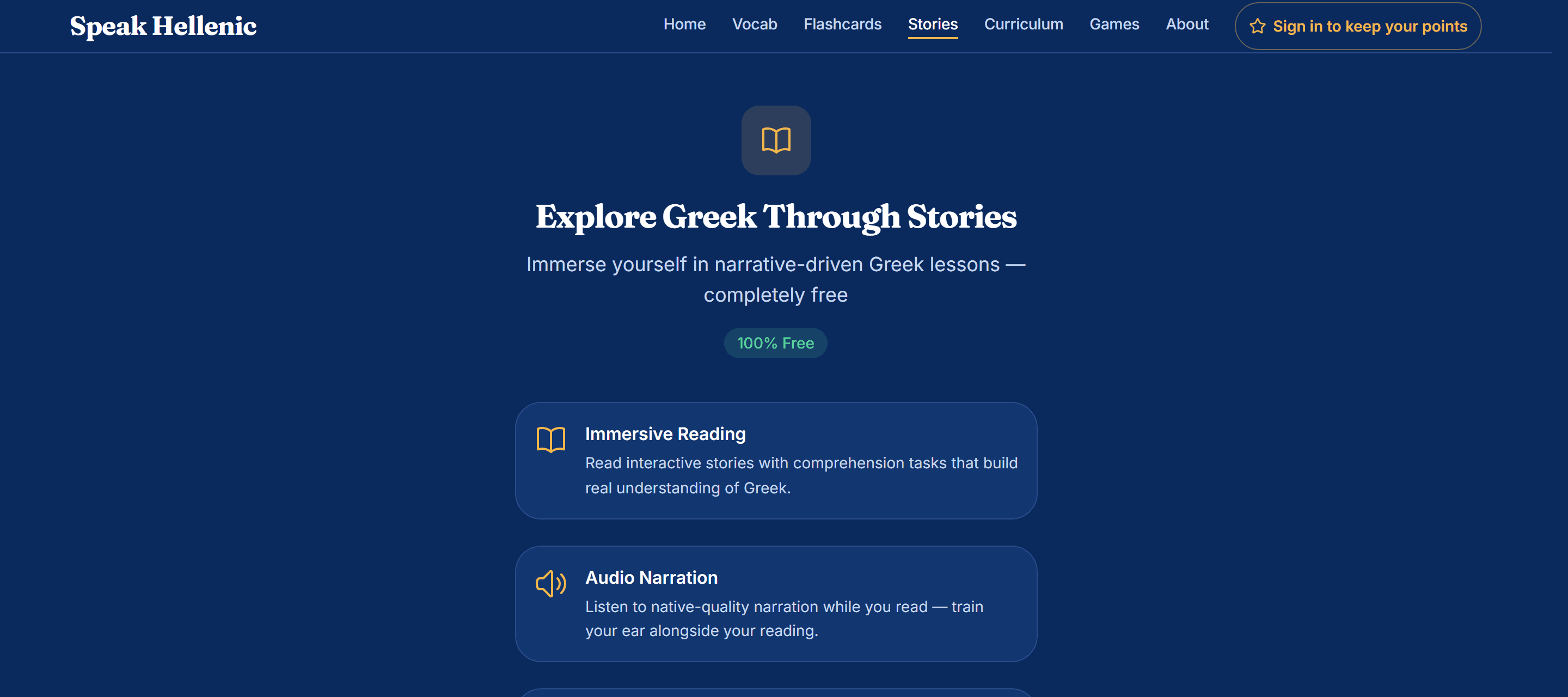
Alongside the course sit the references I kept wishing for: 289 verbs with their conjugations, searchable in Greek, English or transliteration; and longer stories for when you want to read for pleasure rather than progress.
Built for the five minutes you actually have
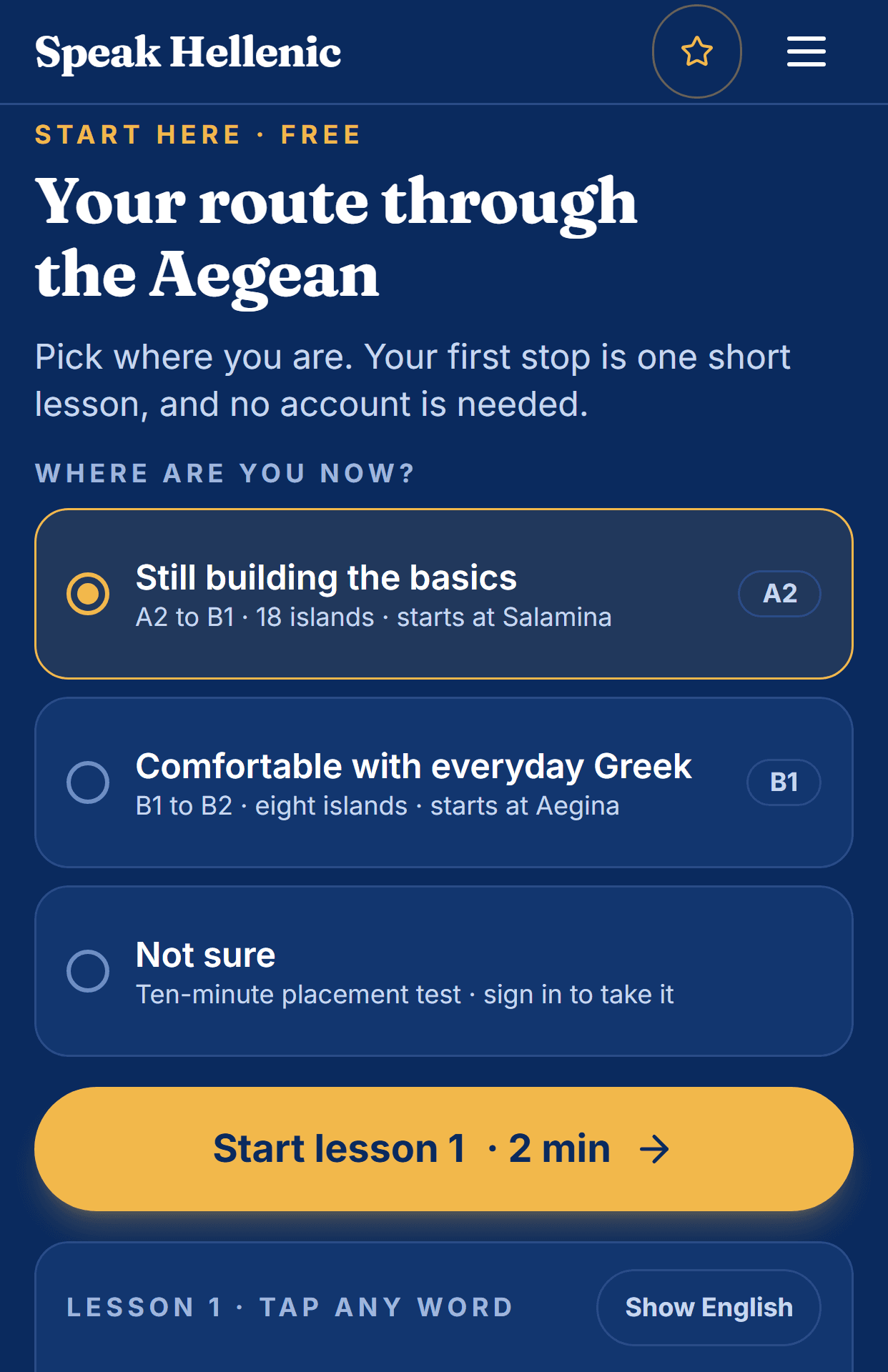
Most language study happens on a phone, in a gap: a train, a queue, ten minutes before bed. So lessons are short, the first one announces itself as two minutes, and saved words queue locally and sync later, because tapping a word on a train with no signal should not lose it.
The engineering, briefly
The product is serverless end to end: Next.js 15 and React 19 on the front, AWS CDK, Lambda, API Gateway, DynamoDB and S3 behind it. Three decisions mattered more than the rest.
A learner's whole state, meaning every saved word and every lesson's progress, lives on a single DynamoDB partition, so loading the chart is one query rather than many. Promoting a word from unknown to learned deletes one item and writes another as a single conditional transaction, so it can never land half done and lose someone's word. And every lesson's audio file is rendered ahead of time and uploaded to S3 instead of being synthesised per request, which removes both the latency and the bill per play.
Analytics are a typed contract rather than scattered calls: 93 events declared in one registry, checked at the call site, gated on consent, with my own sessions tagged out of the numbers. The point is not instrumentation for its own sake. It is being able to answer one question honestly: which lessons do people actually finish?
Over 2,000 tests cover it, including accessibility assertions in the browser suite and nightly checks on audio drift and curriculum readability. Those are the things that rot quietly and that unit tests never notice.
Where it stands
Speak Hellenic is live and in use. To date learners have completed 391 lessons and saved 6,115 words.
The scope is written down and deliberately narrow: a reading route from solid A2 to B2, roughly 120 to 144 hours per path. It is not a classroom replacement covering all four skills. A product that claims to be everything is harder to build and easier to disbelieve.
It exists because the resource I needed did not. That is still the best reason I know to build something.